
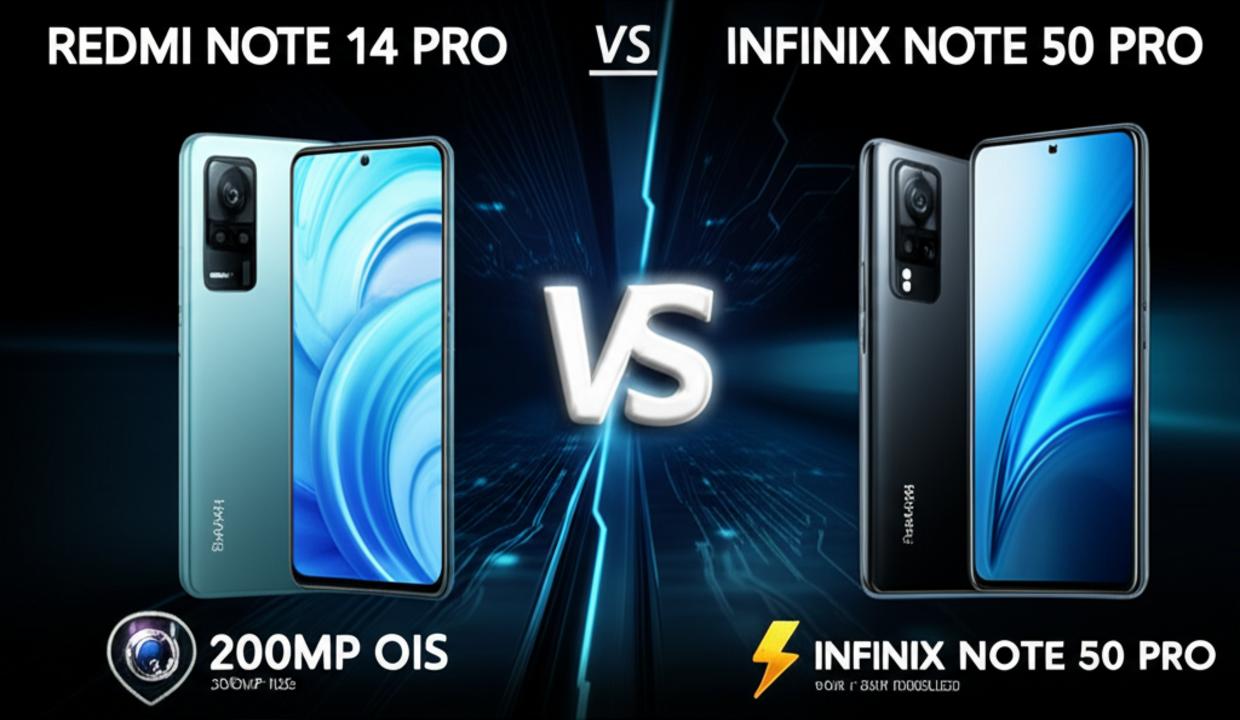
Choosing a new smartphone can feel like navigating a maze, especially with so many incredible options hitting the market. Today, we’re diving deep into a head-to-head battle between two prominent contenders that are making waves in the mid-range segment: the Redmi Note 14 Pro and the Infinix Note 50 Pro. Both promise exceptional value, but they cater to slightly different user priorities. Whether you’re a photography enthusiast, a mobile gamer, or someone who just needs a reliable daily driver with blazing-fast charging, understanding their strengths and weaknesses is key. This comprehensive guide will help you decide: Redmi Note 14 Pro vs Infinix Note 50 Pro: Which phone is best?
Main Highlights: Redmi Note 14 Pro vs Infinix Note 50 Pro: Which phone is best?
The core of your decision between the Redmi Note 14 Pro and the Infinix Note 50 Pro hinges on what you value most in a smartphone. Both devices offer compelling features, but they excel in different areas, making the choice a personal one.
- The Redmi Note 14 Pro truly shines for users prioritizing camera quality and overall imaging capabilities. Its professional-grade 200MP AI main camera with OIS and 4× optical zoom sets it apart.
- On the other hand, the Infinix Note 50 Pro takes the lead for those who demand a buttery-smooth display experience and incredibly fast charging. Its 144Hz refresh rate and 90W wired plus 30W wireless charging are significant advantages.
- For software enthusiasts, Infinix offers the more recent Android 15 out of the box in some variants, compared to Redmi’s Android 14.
- The Redmi Note 14 Pro also offers a slightly more compact and lighter design, complemented by robust Corning Gorilla Glass Victus 2 protection.
Ultimately, while both phones offer excellent mid-range value, the Redmi Note 14 Pro often edges out in photography and build quality, whereas the Infinix Note 50 Pro surpasses it in charging speed and display refresh rate.
Performance and Key Features
A smartphone’s performance is driven by its internal components, primarily the processor, RAM, and storage. Let’s look at how the Redmi Note 14 Pro and Infinix Note 50 Pro stack up under the hood.
The Redmi Note 14 Pro is powered by the MediaTek Dimensity 7300 Ultra chipset. This processor is designed to deliver a smooth and efficient experience, handling everyday tasks and demanding applications with ease. Coupled with 8GB RAM and 256GB storage with UFS 2.2, it ensures snappy app launches, seamless multitasking, and fast data access. This configuration provides a balanced performance for most users, from casual browsing to moderate gaming.
In contrast, the Infinix Note 50 Pro features the MediaTek Helio G100 Ultimate. While this chipset is also capable, especially for gaming in its segment, it might not match the raw processing power or efficiency of the Dimensity 7300 Ultra in all scenarios. However, Infinix often optimizes its software to get the best out of its hardware. The Infinix Note 50 Pro is also likely to offer higher storage options, potentially up to 512GB, which is a big plus for users who store a lot of media and apps.
Both devices run on modern Android versions, with the Infinix Note 50 Pro having an edge with Android 15 compared to Redmi’s Android 14 (in its 4G variants). This means Infinix users might get access to the latest software features and security updates sooner. The Redmi Note 14 Pro, however, includes practical features like Dolby Atmos sound for an enhanced audio experience and an IR blaster, which can be incredibly useful for controlling home appliances. It also offers expandable storage via microSD up to 1TB on its 4G variant, a feature often missed in modern phones. The Infinix Note 50 Pro, meanwhile, boasts newer connectivity with Bluetooth v5.4.
Display and Visual Experience
The display is your window to the digital world, and both the Redmi Note 14 Pro and Infinix Note 50 Pro offer stunning visual experiences, but with key differences that cater to various preferences.
The Redmi Note 14 Pro features a vibrant 6.67-inch AMOLED screen. This display technology is renowned for its deep blacks, excellent contrast, and vivid colors, making content consumption a joy. It boasts a smooth 120Hz refresh rate, which translates to fluid scrolling and a more responsive feel when navigating the interface or playing games. Furthermore, its high resolution of 1220 x 2712 pixels ensures sharp and detailed visuals. A significant advantage for the Redmi Note 14 Pro is the inclusion of Corning Gorilla Glass Victus 2 protection, offering superior durability against drops and scratches. Find more details about the Redmi Note 14 Pro’s robust features on Xiaomi’s official product page.
On the other side, the Infinix Note 50 Pro steps up with a slightly larger 6.78-inch AMOLED display. While also offering the benefits of AMOLED, its standout feature is a faster 144Hz refresh rate. This higher refresh rate provides an even smoother scrolling experience and more fluid animations, which is particularly noticeable in fast-paced games. If you’re a mobile gamer or someone who appreciates the absolute smoothest visuals, the Infinix Note 50 Pro might be more appealing. However, specific details about its display resolution or protective glass are less highlighted, potentially indicating a slight trade-off in these areas compared to the Redmi.
Camera Capabilities: A Photographer’s Dream vs. Everyday Snapper
For many smartphone users, the camera is a primary decision-making factor. Here, the Redmi Note 14 Pro and Infinix Note 50 Pro present distinct philosophies.
The Redmi Note 14 Pro positions itself as a camera powerhouse. It features a flagship-level 200MP AI main camera. This high megapixel count allows for incredible detail and the ability to crop into images without significant loss of quality. Crucially, it comes equipped with Optical Image Stabilization (OIS), which helps in capturing sharper photos and more stable videos, especially in challenging lighting conditions or when subjects are moving. The Redmi Note 14 Pro also offers impressive 4× optical zoom and leverages advanced AI algorithms to enhance image quality, improve dynamic range, and excel in night shots. A recent YouTube review from August 2025 confirms the Redmi Note 14 Pro’s camera prowess, highlighting its vivid 200MP images and balanced performance. For detailed specs on its camera, check out comparisons on NanoReview.
The Infinix Note 50 Pro, while still offering a capable camera system, doesn’t emphasize the raw megapixel count or advanced stabilization features like Redmi. While specific main camera megapixels are not highlighted as a primary strength, its front camera stands out with a higher resolution of 32MP. This is a noticeable step up compared to Redmi’s 20-32MP depending on the variant, making the Infinix Note 50 Pro a strong contender for selfie enthusiasts and video calls. For most everyday photography, the Infinix Note 50 Pro will deliver good results, but it may not offer the same level of detail, low-light performance, or zooming capabilities as the Redmi Note 14 Pro.
Battery Life and Charging Speed: Powering Your Day
Battery life and charging speed are critical for modern smartphone users, ensuring you stay connected and productive throughout your day. This is an area where the Infinix Note 50 Pro makes a significant statement.
The Redmi Note 14 Pro is equipped with a substantial battery capacity, typically ranging around 5110-5500mAh. This large battery should comfortably provide a full day of moderate to heavy use for most users. When it’s time to recharge, the Redmi Note 14 Pro supports 45W turbo fast charging. While 45W is certainly fast and can top up the battery quickly, it’s not the absolute fastest on the market. It’s a reliable and efficient charging solution that ensures you’re not tethered to a wall outlet for too long.
The Infinix Note 50 Pro, on the other hand, truly excels in the charging department. While its exact battery capacity isn’t specified in the provided information, it compensates with an incredibly fast charging solution. It supports a blazing-fast 90W wired charging, which means you can get a significant power boost in a very short amount of time. Even more impressively, the Infinix Note 50 Pro also includes wireless charging up to 30W. This dual charging capability provides unparalleled convenience, allowing you to charge quickly with a cable or effortlessly top up on a wireless pad. This feature is a significant differentiator and a major selling point for the Infinix Note 50 Pro, appealing to users who prioritize rapid power delivery. You can explore more comparative specifications for both devices on Versus.com.
Design, Build, and Ergonomics
Beyond specifications, the physical design and build quality of a smartphone significantly impact the user experience. Both the Redmi Note 14 Pro and Infinix Note 50 Pro offer modern aesthetics, but with subtle differences in their form factors and materials.
The Redmi Note 14 Pro boasts a refined design with dimensions of 162.3×74.4×8.4mm and a weight of approximately 190g. This makes it a slightly more compact and lighter device compared to its competitor. The thoughtful design ensures a comfortable grip and easier one-handed operation for many users. A standout feature in terms of build is the use of Corning Gorilla Glass Victus 2 for display protection. This is a premium addition that significantly enhances the phone’s durability, offering robust resistance against accidental drops and scratches, which is a major advantage for daily wear and tear.
The Infinix Note 50 Pro is slightly larger and a bit heavier, measuring 163.3×74.4×7.3mm and weighing around 198g. Interestingly, despite being heavier, it is marginally thinner, which could contribute to a sleeker feel in the hand for some. The larger screen size (6.78-inch) on the Infinix Note 50 Pro necessitates its slightly larger footprint. While the exact protective glass type isn’t specified, Infinix typically uses durable glass for its displays. The choice between these two largely comes down to personal preference for size, weight, and the added peace of mind that comes with Gorilla Glass Victus 2 on the Redmi Note 14 Pro.
Software Experience and Future-Proofing
The operating system and software updates play a crucial role in a smartphone’s longevity and user satisfaction. Both Redmi and Infinix offer tailored Android experiences, but there’s a slight difference in their current OS versions.
The Redmi Note 14 Pro typically runs on Android 14, overlaid with Xiaomi’s custom user interface, MIUI (or HyperOS, depending on the region and latest updates). MIUI is known for its extensive customization options, feature-rich ecosystem, and often a more integrated set of tools and applications. While Android 14 is a recent and highly capable operating system, the future-proofing aspect hinges on Xiaomi’s commitment to software updates. Xiaomi generally provides several years of security updates and a couple of major Android version upgrades for its Note series, ensuring continued support for the Redmi Note 14 Pro.
The Infinix Note 50 Pro holds an advantage in this specific aspect, coming with the more recent Android 15 (in some variants, particularly 4G ones) right out of the box. Being on a newer Android version means users get access to the latest features, privacy enhancements, and optimizations that come with the newest iteration of Google’s mobile OS. This also suggests that the Infinix Note 50 Pro might receive updates for a slightly longer period or stay current with the latest features for a bit longer. However, the update policy and frequency from Infinix can vary, so it’s always wise to check specific regional commitments. The difference in OS versions could be a deciding factor for users who prioritize having the very latest software on their device.
Pricing and Value Proposition
When considering a new smartphone, value for money is often a primary concern. While specific pricing details can vary greatly by region, retailer, and ongoing promotions, both the Redmi Note 14 Pro and the Infinix Note 50 Pro are positioned as excellent mid-range options, offering premium features without the flagship price tag.
The Redmi Note 14 Pro, with its advanced 200MP OIS camera, robust Corning Gorilla Glass Victus 2 display, and powerful MediaTek Dimensity 7300 Ultra chipset, aims to provide a premium experience, especially in photography and build quality. Its features often align with devices in a higher price bracket, making its competitive pricing a significant draw. It’s an ideal choice for someone who wants flagship-level camera capabilities and durability without breaking the bank. You can often find the Redmi Note 14 Pro available through various retailers, for example, check out the Redmi Note 14 Pro 5G in Black for potential pricing and availability.
The Infinix Note 50 Pro, on the other hand, delivers exceptional value through its cutting-edge charging technology (90W wired + 30W wireless) and an ultra-smooth 144Hz display. These features are typically found in more expensive smartphones, making the Infinix Note 50 Pro a compelling option for power users and gamers who prioritize fast charging and a fluid visual experience above all else. Its slightly newer Android version also adds to its long-term value. Both phones are strong contenders in the competitive mid-range market, and your personal priorities will ultimately determine which one offers the ‘best’ value for your specific needs.
Pros and Cons
| Pros | Cons |
|---|---|
| Redmi Note 14 Pro: – Flagship-level 200MP AI main camera with OIS and 4× optical zoom – Durable Corning Gorilla Glass Victus 2 display protection – Powerful MediaTek Dimensity 7300 Ultra chipset – Dolby Atmos sound and IR blaster – Slightly more compact and lighter design – Expandable storage up to 1TB (4G variant) |
Redmi Note 14 Pro: – Slower 45W wired charging; no wireless charging – 120Hz display refresh rate (vs. Infinix’s 144Hz) – Older Android 14 (vs. Infinix’s Android 15) – Lower front camera resolution (20-32MP vs. Infinix’s 32MP) |
| Infinix Note 50 Pro: – Blazing-fast 90W wired charging and 30W wireless charging – Smoother 144Hz AMOLED display – More recent Android 15 OS out of the box – Higher resolution 32MP front camera – Likely higher storage option (up to 512GB) – Newer Bluetooth v5.4 |
Infinix Note 50 Pro: – Main camera lacks 200MP and OIS (based on provided info) – Less powerful processor (MediaTek Helio G100 Ultimate) – No specific mention of advanced display protection like Gorilla Glass Victus 2 – Slightly heavier and larger design – No IR Blaster or Dolby Atmos mentioned |
Comparative Analysis and Expert Opinions
To truly understand which device wins, it’s essential to look at how they perform against each other in real-world scenarios, factoring in expert insights. Both the Redmi Note 14 Pro and the Infinix Note 50 Pro are strong contenders in their segment, but they cater to different priorities.
The Redmi Note 14 Pro consistently stands out in camera performance. According to a recent YouTube review from August 2025, the Redmi Note 14 Pro’s 200MP camera delivers exceptionally vivid and detailed images, especially in good lighting, and its OIS significantly enhances stability for both photos and videos. This makes it the undisputed champion for photography enthusiasts looking for professional-grade imaging without the premium price tag. Its robust build with Corning Gorilla Glass Victus 2 also provides a tangible advantage in terms of durability, offering peace of mind for daily use. Users who value a more compact device will also lean towards Redmi.
Conversely, the same review and various tech analyses highlight the Infinix Note 50 Pro’s superior charging speeds and display fluidity as its strongest points. The 90W wired charging is a game-changer for users constantly on the go, minimizing downtime, and the inclusion of 30W wireless charging further adds to its convenience. The 144Hz display offers a noticeably smoother experience, especially for gaming and general navigation, outperforming Redmi’s 120Hz. While its main camera might not match Redmi’s 200MP sensor, its higher resolution 32MP front camera makes it a better choice for selfie lovers and content creators focused on vlogging. In terms of software, the Infinix Note 50 Pro’s Android 15 out-of-the-box offers a slight edge in future-proofing. For a detailed comparison of specifications, you can check out platforms like Smartprix.
In essence, the Redmi Note 14 Pro performs better for users who prioritize a top-tier camera and robust build, while the Infinix Note 50 Pro excels for those who demand the fastest charging, a smoother screen, and the latest Android version. Your choice truly depends on your individual daily usage and what features enhance your mobile experience the most.
FAQ
- Q1: Which phone has a better camera, the Redmi Note 14 Pro or Infinix Note 50 Pro?
The Redmi Note 14 Pro is superior for camera quality, featuring a 200MP AI main camera with OIS and 4× optical zoom for professional-grade imaging. The Infinix Note 50 Pro has a higher resolution 32MP front camera for selfies, but its main camera isn’t as highlighted for advanced features. - Q2: Which phone charges faster: Redmi Note 14 Pro or Infinix Note 50 Pro?
The Infinix Note 50 Pro charges significantly faster, supporting 90W wired charging and 30W wireless charging. The Redmi Note 14 Pro offers 45W turbo fast charging, which is still quick but not as rapid as the Infinix. - Q3: Is the display smoother on the Redmi Note 14 Pro or Infinix Note 50 Pro?
The Infinix Note 50 Pro offers a smoother display experience with its 144Hz AMOLED screen. The Redmi Note 14 Pro also features a smooth 120Hz AMOLED display, but the Infinix’s higher refresh rate provides a marginally more fluid visual. - Q4: Which phone is more durable between the two?
The Redmi Note 14 Pro is likely more durable due to its Corning Gorilla Glass Victus 2 protection on the display, which offers enhanced resistance against drops and scratches. The Infinix Note 50 Pro’s display protection details are not as prominently highlighted. - Q5: Which phone runs on a newer Android version?
The Infinix Note 50 Pro runs on the more recent Android 15 (in some variants), while the Redmi Note 14 Pro typically comes with Android 14. This gives the Infinix a slight edge in terms of the latest software features and potential future-proofing.
Conclusion
In the exciting showdown between the Redmi Note 14 Pro and the Infinix Note 50 Pro, it’s clear that both devices offer compelling value in the competitive mid-range smartphone market. Your ultimate choice depends on your specific priorities and what features matter most for your daily usage. #SmartphoneComparison
If you’re a photography enthusiast who prioritizes a professional-grade camera, outstanding image detail, and strong build quality, the Redmi Note 14 Pro is the superior choice. Its 200MP AI camera with OIS and robust Corning Gorilla Glass Victus 2 make it a compelling package for capturing life’s moments and ensuring device longevity. It delivers balanced overall performance thanks to its Dimensity 7300 Ultra chipset.
However, if your primary concerns are incredibly fast charging, a super-smooth display, and the very latest Android software, then the Infinix Note 50 Pro undeniably takes the lead. Its 90W wired and 30W wireless charging capabilities are a major convenience, and the 144Hz AMOLED screen provides a visually fluid experience, especially for gaming and navigation. Running on Android 15 further enhances its appeal for those who value software currency.
Both phones represent excellent value. We encourage you to weigh these key differences against your personal needs. Share your thoughts in the comments below, and don’t forget to learn more About Us or explore our other articles for more tech insights. If you have further questions, feel free to Contact us.
Watch More in This Video
While we don’t have a specific video URL to embed right now, you can often find comprehensive reviews and comparisons of the Redmi Note 14 Pro and Infinix Note 50 Pro on YouTube. Search for “Redmi Note 14 Pro vs Infinix Note 50 Pro review” to see detailed performance tests, camera samples, and battery comparisons firsthand.
Disclaimer: All images and videos are sourced from public platforms like Google and YouTube. If any content belongs to you and you want credit or removal, please inform us via our contact page.